

Building certification involves an independent review and approval process for construction projects, ensuring compliance with safety, health, amenity, and sustainability standards at three distinct levels.
- Local Council
- State Government
- Nationally under the National Construction Code
Builders notify a building certifier to conduct inspections and approve work at various stages throughout the construction process. Following each approval, notifications are sent to the building owner.
Refer to Form 16 – Inspection Certificate for more details.
Understanding Inspections for Class 1a to Class 10 Buildings
Buildings are categorised into various classifications.
At A1 Certifier, we handle all types of building classifications, with a significant focus on Class 1a Buildings, which encompass residential homes.
Class 1a buildings refer to individual houses or dwellings that are primarily residential. This category includes standalone houses, duplexes, townhouses, villa units, and terrace houses.
Essential Inspections for Class 1a and Class 10 Buildings
- Footing – This inspection occurs after excavating the foundation material and prior to the concrete being poured for the footings or floor slab.
- Floor slab – If the building includes a floor slab, an inspection is conducted after placing the formwork and reinforcement, but before pouring the concrete.
- Frame – A thorough inspection of the frame is required (see the breakdown in section 44 of the Building Regulations 2021).
- Final acceptance – This inspection assesses all remaining items, including certificates for termite protection, wet area membranes, glazing, smoke detectors, and energy efficiency.
During the final inspection of Class 1a buildings, we ensure compliance across the following critical areas:
- Siteworks and drainage
- Termite management systems
- Damp and weatherproofing
- Fire safety
- Health and amenity
- Safe movement and access
- Construction of wet areas
- Glazing
- Sub-floor ventilation
- Energy efficiency
- Water conservation measures
Exploring Our Comprehensive Certification Process
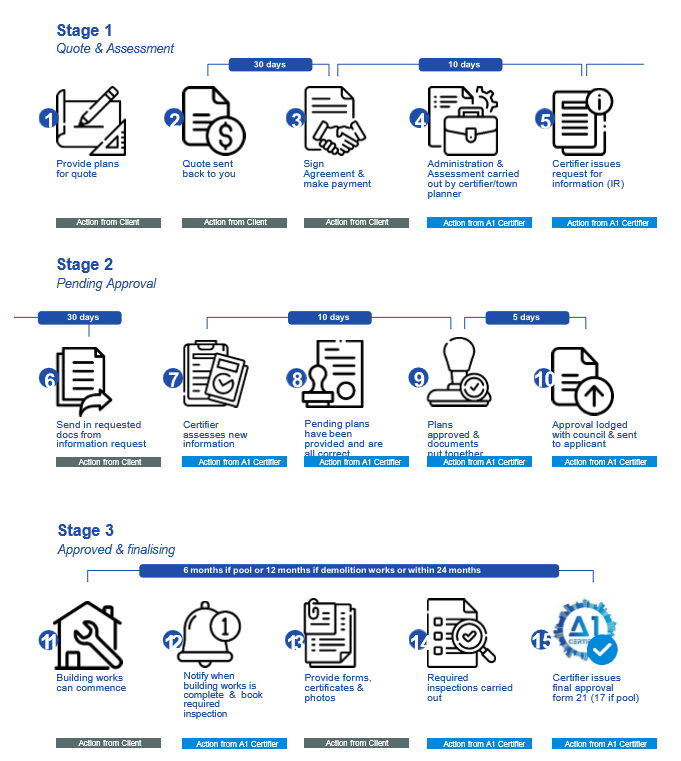
Common Misunderstandings About Engaging a Building Certifier
A building certifier does not oversee a construction project, nor are we acting as building inspectors.
Our primary responsibility is to verify that builders adhere to the approved building plans and that each mandatory inspection meets the standards set by local councils, the state government, and the National Construction Code.
A1 Certifier is committed to ensuring that the builders we collaborate with execute construction to the highest standards.
We do not overlook substandard work since we must approve all completed work, and our reputation and licensing depend on it.
If any aspects of the construction deviate from the approved plans, we provide guidance on necessary corrections to ensure compliance.
We keep our clients updated on the progress of their construction approvals.
Contact A1 Certifier today to discuss your upcoming building projects.
We operate throughout Queensland, from the Gold Coast to Ipswich and up to Mackay.
Original Article First Published At: How Does Building Certification Work?