

Quick Summary: In New South Wales, the law determines the ownership of a boundary tree based on where the trunk is rooted in the ground, not where the branches extend. According to the Trees (Disputes Between Neighbours) Act 2006, the Land and Environment Court may issue orders regarding a tree only if at least half of the trunk is located on the land of the landholder.
The landholder of the tree is responsible for its maintenance. Actions regarding any branches that extend into your property involve additional considerations, which can vary based on your local council's regulations.
Important Reminder: This information serves as a general overview of the process in NSW and does not constitute legal advice. It does not predict outcomes for specific cases. Each boundary tree situation is unique, and for significant disputes, seeking legal counsel is advisable.
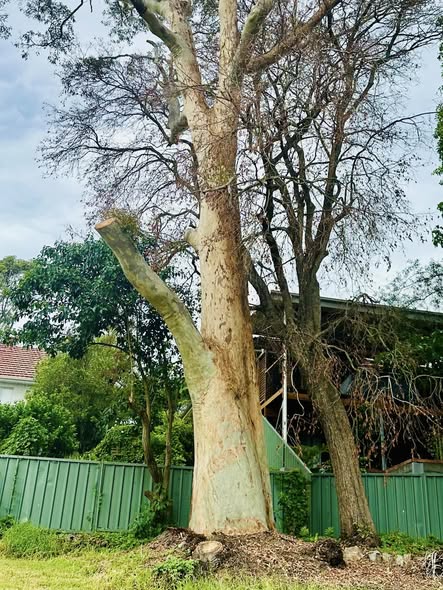
How Does NSW Law Define a Boundary Tree?
The Trees Act provides a clear framework for the Court's authority. To issue an order regarding a tree, the Court must establish that the tree is situated primarily on the land of the person in question, specifically requiring that at least fifty per cent of the trunk is rooted on that land (Trees Act, section 4(3), as summarised by the State Library of NSW legal guide on trees and plants). Hence, a tree that leans significantly over your property, shedding leaves on your roof and casting shade over your back door, may still be classified as residing entirely on your neighbour's land, as determined by the position of its trunk.
Two additional criteria apply: the tree must be located on privately owned land within an urban zone to which the Act pertains, and it must border the land of the affected neighbour (sections 4, 7, and 14B, as outlined by the Land and Environment Court). The term “adjoining” has been interpreted broadly to include properties that connect diagonally, even if they only share a corner post (Cavalier v Young [2011] NSWLEC 1080, as noted in the State Library of NSW guide). this does not extend to trees located several houses away.
It's essential to understand what qualifies as a tree under this legislation, as the definition is broader than many assume. Legal Aid NSW clarifies that a tree encompasses any woody perennial plant and any plant resembling a tree in both form and size. This definition includes bamboo, tiger grass, giant clumping grass, and vines (Legal Aid NSW, Trees). Legal Aid NSW also describes a hedge test, which requires two or more trees exceeding 2.5 metres in height, measured from ground level, that are planted together to form a hedge.
In cases where a trunk straddles the boundary, the situation becomes complex and is not something that can be resolved through casual online research. In such instances, seeking professional guidance before taking any action is crucial.
Understanding Your Responsibilities for a Boundary Tree
According to Legal Aid NSW, the responsibility for maintaining trees falls squarely on the property owner. This typically means that the owner is accountable for arranging inspections, pruning, and, if necessary, removal. They must also navigate the council approvals required for these actions.
Ownership of the tree does not grant unrestricted rights over it. In the City of Newcastle, trees that reach three metres or more in height, or possess a trunk diameter of 15 centimetres or more measured 1.4 metres above the ground, are classified as vegetation and require council permission prior to any clearing. Pruning is subject to different guidelines; no permit is needed for pruning declared vegetation if it does not constitute clearing under the Biodiversity and Conservation SEPP definition, and the work is performed in accordance with AS 4373:2007 by an individual certified to AQF Level 3 in Arboriculture or higher (Newcastle DCP 2023, Section C3, control C-3). This underscores the importance of employing a qualified arborist for boundary trees instead of relying on someone with just a ladder.
Can You Trim Overhanging Branches to the Boundary?
This is a common query, and the straightforward answer is that it varies based on your local council and the specific tree in question. Legal Aid NSW recommends discussing overhanging branches with your neighbour and consulting your local council before trimming back to the boundary, as certain trees are protected and require council approval prior to any cutting. Interfering with a protected tree can result in fines. It is also vital to refrain from trespassing on your neighbour’s property or damaging the tree without their consent.
Local regulations differ significantly across the councils we frequently engage with:
- Lake Macquarie: Branches from native trees extending over from a neighbouring property can be pruned back to the boundary as long as the pruning does not exceed 10 per cent of the tree canopy (Lake Macquarie City Council, tree pruning and removal).
- Maitland: If a tree on an adjacent property overhangs your boundary and you cannot obtain written consent from the owner, the council may approve pruning of the tree only to the common property boundary (Maitland City Council, Application Guide for Tree Removal and Pruning).
- Newcastle: Pruning that does not amount to clearing and is executed according to AS 4373 by a qualified individual at AQF Level 3 or above does not require a permit; any pruning beyond that will.
Maitland clarifies that the council cannot approve the removal or pruning of a tree on a neighbour’s property without the owner’s consent. any application made on behalf of an owner must include that consent.
Both Maitland and Lake Macquarie outline the limits as being strictly to the boundary and not beyond, each imposing its own conditions. These conditions ultimately dictate your obligations, so contacting your council is essential before commencing any work. The question of who bears the cost of trimming is not addressed by these regulations, leaving it up to both parties to negotiate. Our guide on neighbour tree disputes provides further insights on what to do when an agreement cannot be reached. For larger jobs, proper tree pruning by a qualified arborist helps protect the tree and ensures compliance with council regulations.
Who Bears the Costs When a Boundary Tree Causes Damage?
There is no straightforward rule that assigns automatic financial responsibility to the tree’s owner. The official guidelines outline a process and criteria to determine liability, rather than providing guarantees about outcomes.
Regarding storm-related damage, Legal Aid NSW states that if your neighbour’s tree falls onto your property during a storm, your neighbour may not necessarily be liable for the damages. They can only be held accountable if they were aware or should have been aware of the tree's potential danger. When it comes to insurance, it’s essential to review your product disclosure statement to understand your coverage, as this is a matter to discuss with your insurer.
If an agreement cannot be reached, the Trees Act outlines a pathway for resolution. Legal Aid NSW suggests practical initial steps: document the damage with photographs, communicate with your neighbour, and obtain a written quote for repairs. If negotiation or mediation fails, an application can be made to the Land and Environment Court, which may order the tree's removal or maintenance, or mandate compensation.
What Must the Court Confirm Before Proceeding with a Tree Dispute?
Section 10 of the Trees Act outlines the criteria for whether an application progresses. As detailed in the State Library of NSW guide, the Court cannot issue an order under Part 2 unless it is satisfied of three conditions:
- Agreement: The applicant has made a reasonable effort to reach an agreement with the other party.
- Notice: The applicant has provided proper notice of the application.
- Harm: The tree has caused, is causing, or is likely to cause damage to the applicant’s property, or is likely to pose a risk of injury to an individual.
Regarding the second criterion, notice must be given at least 21 days in advance under section 8, including the specifics of the order sought. The Land and Environment Court requires that the application be served to both the neighbour and the local council at least 21 days before the preliminary hearing.
If these conditions are fulfilled, the Court examines the matters outlined in section 12. The State Library of NSW guide identifies several key factors, including:
- Position: The tree's location concerning the boundary and any adjacent premises.
- The tree itself: The potential impact of pruning on the tree.
- Amenity: The tree's contributions to privacy, landscaping, heritage value, and protection from sun, wind, and noise.
- Environment: The tree’s role in the local ecosystem and biodiversity, as well as its influence on soil stability and the water table.
- Other causes: Any factors other than the tree that may have contributed to the damage, including actions or negligence by the applicant.
- Conduct: The measures either party has already taken to prevent or rectify the issue.
The Court has also clarified that ordinary mess caused by trees is insufficient grounds for action. Typical occurrences such as shedding leaves, flowers, fruit, seeds, or small amounts of deadwood do not usually warrant an order to interfere with or remove a tree, a principle established in the case of Barker v Kyriakides [2007] NSWLEC 292 and summarised in the State Library of NSW guide.
Two practical considerations often catch people by surprise. If a tree has damaged a dividing fence on the boundary and the applicant requests repairs for that damage, the Land and Environment Court may also issue an order concerning the dividing fence under section 13A of the Dividing Fences Act 1991. orders made under the Trees Act may, in certain circumstances, be binding on subsequent owners of the land, as noted in sections 16 and 16A (State Library of NSW guide). This knowledge is crucial for those buying or selling properties with known tree issues.
In terms of timing, Legal Aid NSW advises that you have six years from the date of property damage to claim compensation, and there is no time limit for applying to the Court unless compensation is sought. The Land and Environment Court indicates that the preliminary hearing typically occurs four to six weeks after filing, with applications under the Trees Act usually resolved within three months.
Steps for Resolving Boundary Tree Issues Effectively
- Identify where the trunk enters the ground, as this determines the ownership of the tree according to the Act.
- Contact your council to inquire whether the tree is protected and what pruning is permitted at your location.
- Have the tree professionally assessed if safety or damage concerns arise, so both you and your neighbour are making decisions based on facts rather than assumptions.
For comprehensive guidance on the formal procedures, including mediation and necessary filings, refer to our detailed guide on handling tree-related disputes with neighbours in NSW. The most common issues we encounter involve roots lifting pathways or infiltrating drainage systems, as well as branches falling onto fences, roofs, and vehicles.
The Role of a Qualified Arborist in Managing Boundary Trees
Our focus is solely on the tree itself. We conduct thorough assessments of its structure and health, providing clear insights into whether your concerns are warranted or if the tree is simply exhibiting typical behaviour. If pruning is required, we adhere to AS 4373 standards to ensure the tree heals properly and maintains its stability. When removal is necessary, we will discuss the process with you and ensure compliance with council regulations.
We serve Newcastle, Lake Macquarie, Maitland, and the broader Hunter region, bringing experience since 1998. Questions of liability should be addressed with a solicitor or the Court. Our expertise lies in understanding the tree's condition and needs.
Sources of Boundary Tree Regulations
- Land and Environment Court of NSW, tree and hedge disputes, application initiation, outcomes, and orders
- Legal Aid NSW, Trees
- State Library of NSW, Trees and plants
- Newcastle DCP 2023, Section C3 Vegetation preservation and care
- Lake Macquarie City Council, tree pruning and removal
- Maitland City Council, Application Guide for Tree Removal and Pruning
Common Queries About Boundary Tree Responsibilities
Who owns a tree if it grows on the boundary line?
According to the Trees (Disputes Between Neighbours) Act 2006, the Land and Environment Court can only issue orders for trees that are wholly or primarily situated on a person's property, which is defined as having at least fifty per cent of the trunk entering the ground there. The presence of branches or roots crossing the boundary does not alter this assessment. If a trunk genuinely straddles the boundary, the situation is complex, so seek legal advice before proceeding with any cutting.
Am I allowed to cut branches from my neighbour’s tree that extend over my fence?
It depends on your council and the specific tree. Legal Aid NSW recommends that you first discuss the situation with your neighbour and consult your council, as protected trees require permission for any alterations, and interfering with one can result in penalties. In Lake Macquarie, for instance, you can prune overhanging branches of native trees back to the boundary, provided the pruning does not exceed 10 per cent of the canopy. Remember, you cannot enter your neighbour’s property without their consent.
Who is responsible for the upkeep of a tree on the boundary?
Legal Aid NSW states that property owners are responsible for the maintenance of trees on their land. A tree is considered to be on a person's property if at least fifty per cent of its trunk is rooted there. The owner is responsible for arranging inspections, pruning, and acquiring council approvals, which still apply even for trees situated on their own land.
Is my neighbour’s permission necessary to submit a council application regarding their tree?
Yes. Maitland City Council indicates that it cannot authorise the removal or pruning of trees on a neighbour’s property without that owner’s consent. Any application submitted on behalf of an owner must include the necessary consent. This approach is consistent across other councils in the area, so it's advisable to verify with your local council.
What if the tree is protected or designated as heritage on the boundary?
Protection regulations apply to the tree, including any portion that extends over your side of the boundary. Being on your side of the fence does not exempt it from protection. You must adhere to your council’s processes, and in Newcastle, trees classified as heritage items or visible from the street within a heritage conservation area are completely outside the usual exemptions. It is crucial to have the tree assessed before taking any actions.
Original Article First Published At: Who’s Responsible for a Tree on the Boundary in NSW?