

When selecting new glasses, individuals typically concentrate on two main aspects: the prescription and the frame.
This focus is understandable. The prescription is crucial for correcting light, while the frame is what is visible in the mirror. Both elements require thoughtful consideration.
Many people overlook a vital third aspect that can greatly influence how glasses feel and function: the lens design itself.
Two pairs of glasses may have identical prescriptions yet feel remarkably different when worn. One pair can provide immediate comfort, while the other may leave the wearer feeling strained, experiencing distortion, or uncertain about why the glasses don’t feel quite right.
Often, the distinction lies not in the prescription but in how the lenses are tailored to meet the specific needs of the wearer.
At Eyes by Design, Dr Nicholas Altuneg (Dr Nick) frequently observes this phenomenon: modern lenses boast a level of sophistication that many people are unaware of, and the design of the lenses significantly influences how smoothly vision operates over various distances, how stable the visual field feels during movement, and how comfortable the eyes remain throughout the day.

Understanding the Prescription: What Needs Correction Versus Lens Construction
A prescription serves as the foundation for every pair of glasses.
It indicates how light should be adjusted to achieve clear focus on the retina through the optical centre of the lens. This is essential, yet it does not guarantee that every lens crafted to that prescription will perform identically.
Lens design encompasses more than simply inserting prescription numbers into a lens. It involves how the lens manages vision across its entire surface, how it performs away from the optical centre, how seamlessly it transitions between different viewing zones, and how effectively it supports the wearer.
While the prescription indicates what requires correction, the design of the lens significantly influences how that correction is implemented. This distinction is particularly important for individuals who wear their glasses throughout the day, engage in activities at varying distances, or are sensitive to visual discomfort.
Exploring the Variability in Lens Design
It is a common misconception that lenses become uniform once a prescription is applied. In reality, lenses can be constructed using a variety of optical methodologies.
More traditional designs often rely on average values and standard assumptions. While this may serve many individuals adequately, it fails to consider the unique characteristics of each eye.
In contrast, advanced lenses adopt a more personalised approach, incorporating additional data about the wearer’s eyes and how the frame will sit on their face. This tailored design can significantly enhance comfort and performance.
At Eyes by Design, lens recommendations are made with care rather than as a routine process. The aim is not just to create technically sound eyewear, but to provide glasses that feel natural and perform excellently in real-world situations.
What Makes Some Glasses Easier to Adapt To?
Most individuals find it easy to adjust to new glasses. there are instances when someone puts on a new pair and instantly senses something amiss.
They may describe the lenses as “strange,” “different,” or “less comfortable than my previous pair.” Common issues include edge blurring, a feeling of distortion while walking, or an increased awareness of the lenses when switching tasks.
These feelings are not always due to an incorrect prescription.
The design of the lens plays a crucial role in how smoothly the brain adapts to new glasses. When the optics are managed with greater precision across the lens, the visual experience tends to be more stable and intuitive. This explains why one pair may feel effortless, while another with a nearly identical prescription does not settle well.
The Importance of Biometric Lens Design
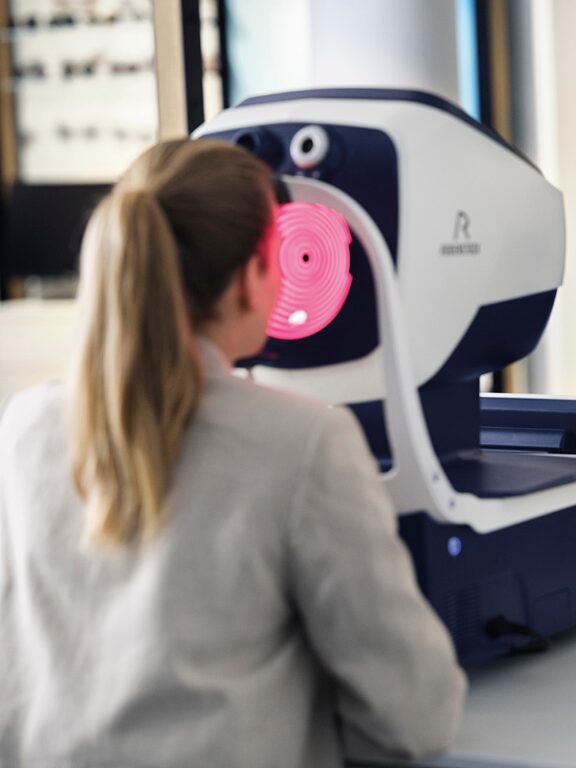
One of the significant advancements in contemporary eyewear is the incorporation of biometric data into lens design.
Biometric technology utilises detailed information about your eye, allowing lenses to be customised to your eye's actual structure and optical behaviour, rather than relying on averages.
Technologies like Rodenstock’s biometric lenses exemplify this approach. They avoid the assumption that one eye behaves similarly to the other by employing real eye data to create a more personalised lens.
This methodology is not about complicating lens design unnecessarily. It aims to bridge the gap between theoretical lens performance and practical application for real individuals in everyday situations. For some patients, the benefits may be subtle. For others, particularly those with high visual demands, the added precision translates into enhanced comfort, easier adaptation, and a more natural visual experience.

How Frame Fit Affects Lens Performance
Even a well-crafted lens requires proper placement in front of the eye.
This is why careful frame fitting and accurate lens positioning are as crucial as the design of the lens itself. At Eyes by Design, the dispensing process incorporates advanced measurement systems, ensuring that lens design is considered alongside the selected frame. This guarantees that the final glasses enhance the wearer’s visual experience.
Such a holistic approach ensures the lens’s performance remains intact once the glasses transition from the consulting room into daily life.
Why Lens Design Is Increasingly Significant
Contemporary life places considerable strain on our eyes.
Glasses are expected to facilitate a broad spectrum of visual tasks, often for prolonged periods. This is precisely why thoughtful lens design is more critical now than ever.
Minor variations in optical performance may have gone unnoticed in a less visually demanding era. Today, these differences can significantly impact how comfortable you feel by day's end and how effectively your glasses adapt to the rigours of modern life.
Achieving Optimal Vision
At Eyes by Design, selecting lenses is not treated as a mere transaction.
It forms part of a broader philosophy known as Vision, Done Properly, which emphasises that good vision relies on more than just updating a prescription. It also hinges on how lenses are designed, how accurately they match the wearer’s needs, and how effectively the finished glasses accommodate daily visual demands.
Dr Nick often emphasises that the best eyewear solutions arise from a comprehensive understanding of the entire system: the eyes, the lens design, the frame, and the lifestyle of the individual wearing the glasses.
Fostering Confident Vision for Life
Over 80% of the information we gather from the world is visual. For the majority, glasses are worn throughout the day and relied upon for various activities.
When lens design is selected with care, glasses can feel more natural, stable, and supportive all day long.
If you’ve ever questioned why some glasses feel better than others, the design of the lens often plays a significant role in the answer.
At Eyes by Design, Dr Nick and his team invest time in understanding each patient’s unique visual needs, ensuring that lenses, frames, and eye care work harmoniously to promote confident vision for life.
Frequently Asked Questions
Are all glasses lenses similar once the prescription is applied?
No. Lenses can be designed in various ways, which can influence clarity, comfort, adaptation, and the overall smoothness of vision across the lens.
What is biometric lens design?
This approach uses detailed data about your eye to create a more personalised lens, rather than relying on standard average models.
Why do some new glasses feel easier to adjust to than others?
While prescription is one factor, lens design, frame positioning, and how closely the optics align with the wearer’s needs all contribute to how natural new glasses feel.
Does superior lens design genuinely make a difference?
For many individuals, yes. The advantages include smoother vision, reduced strain, easier adaptation, and a more natural visual experience throughout the day.
Original Article First Published At: Why Lens Design Matters More Than Most People Realise