
Spotted gum decking is a robust Australian timber renowned for its durability in outdoor conditions. The diverse colour palette complements both traditional Queenslanders and contemporary designs, with timber sourced locally in Queensland.
It has its drawbacks. The boards are heavy, and without regular oiling, a spotted gum deck will develop a grey patina. Here’s what you need to consider when selecting spotted gum decking for your deck.
Understanding the Origin of Spotted Gum Decking
Spotted gum refers to several species of closely related gum trees, named for their distinctive bark, which sheds in patches, creating a spotted appearance on the trunk. According to Business Queensland’s timber profile, these trees thrive from eastern Victoria to North Queensland, making spotted gum the most abundant native hardwood harvested in Queensland.
The same profile indicates that sawn spotted gum is widely available and used across various applications, from flooring and cladding to marine decking. Business Queensland highlights its prominence as the preferred Australian timber for high-impact tool handles, such as axe handles.
Key Reasons Spotted Gum Decking is Ideal for Outdoor Use
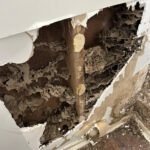
Durability is the primary factor for choosing spotted gum. Business Queensland rates it as Class 1 for above-ground durability, with a life expectancy exceeding 40 years, and notes its resistance to termites.
Class 1 represents the highest rating in the Australian standard for natural durability, AS 5604. WoodSolutions provides clarity on these classifications, placing spotted gum in Class 1 alongside ironbark and tallowwood.
It is important to understand two key aspects of this rating:
- The rating applies solely to heartwood: sapwood, the lighter outer layer of the log, lacks durability across all species and requires preservative treatment for outdoor use.
- It assumes proper detailing: WoodSolutions emphasises that inadequate ventilation and trapped moisture can significantly reduce the lifespan of even the most durable timber.
A spotted gum deck will endure when primarily constructed from heartwood and designed for optimal airflow and drainage.
Considerations for Spotted Gum Decking Near Ground Level
Low decks require additional consideration. WoodSolutions advises that decks with less than 400 mm of clearance must use Class 1 hardwood or timber treated to H4. Spotted gum heartwood meets this standard, yet the subframe of a low deck must also accommodate the conditions, with airflow beneath the boards becoming increasingly critical as the height decreases.
Visual Characteristics of Spotted Gum Decking
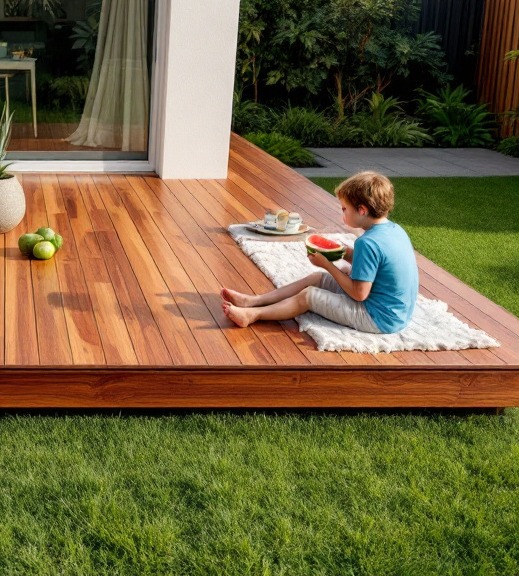
According to Business Queensland, the heartwood of spotted gum ranges from light brown to dark red-brown, contributing to its visual appeal. A spotted gum deck typically exhibits a non-uniform appearance, with variations in texture across different boards. Common features include gum veins—thin dark lines in the grain—and a wavy grain that can create a fiddleback pattern. If you prefer a perfectly uniform look, consider inspecting gum veins in person before making a purchase.
The sapwood is distinctly white and may appear along one edge of some boards. Inquire about the grading of boards that include sapwood and whether they have been treated, as untreated spotted gum is vulnerable to lyctid borer infestations, as noted by Business Queensland.
Understanding How Spotted Gum Decking Ages in Sunlight
If left untreated, any timber deck in Brisbane will gradually fade to a silver-grey hue. WoodSolutions clarifies that natural durability does not prevent weathering; the surface can grey and develop fine surface cracks without a protective finish.
If you appreciate the silver appearance, note that WoodSolutions still recommends applying finishes and ensuring proper detailing. To maintain the warm tones, regular application of decking oil or stain is essential, along with re-coating when the surface appears dry. Decks exposed to full afternoon sun will require more frequent maintenance than those in shaded areas.
Essential Insights for Working with Spotted Gum Decking
Spotted gum is a dense timber, with Business Queensland reporting a density of approximately 1010 kg per cubic metre, making it challenging to work with hand tools. When constructing a deck, consider the following:
- Weight: The boards are heavy, necessitating more effort to carry and lay compared to softwoods.
- Fixings: Business Queensland notes that standard fittings and fastenings can be used without difficulty.
- Machining: The timber's natural greasiness aids in achieving clean cuts and planes during machining.
This density is also why spotted gum withstands foot traffic, outdoor furniture, and the claws of pets effectively. It is less prone to marking than softer timbers.
Comparing Spotted Gum Decking to Other Hardwoods
WoodSolutions categorises common timber species by their durability class. Here’s how spotted gum ranks:
- Class 1, very durable: spotted gum, ironbark, and tallowwood, all expected to last over 40 years in above-ground applications.
- Class 2, durable: blackbutt, jarrah, and silvertop ash, with a lifespan of 15 to 40 years above ground.
- Class 3, moderately durable: Vic ash and Tasmanian oak, lasting between 7 to 15 years above ground.
If longevity is your primary concern, spotted gum ranks among the best choices. Colour preferences are subjective, so it’s advisable to view boards from different timber types side by side before making your final decision.
For further comparisons, our page on timber decks explores various timber options and the essential elements for building a long-lasting deck.
Crucial Questions to Consider Before Ordering Spotted Gum Decking
Asking the right questions upfront can prevent unexpected issues later. Before placing your order, consider these inquiries:
- Grade: What grade of spotted gum decking is being quoted, and how many gum veins and knots are permissible for that grade?
- Sapwood: Are any boards carrying sapwood, and if so, has it been treated?
- Seasoning: Are the boards kiln-dried to ensure they have settled properly before installation?
- Width: What board width is suitable for your deck’s size and desired aesthetic?
- Fixings: Which screws or hidden fixings will be used, particularly if you reside near the coast?
- Finish: Will the deck be oiled before delivery, or is that a task you will undertake yourself?
Essential Maintenance for a Spotted Gum Deck
Maintaining a spotted gum deck requires similar care to any timber deck.
- Regular sweeping: Remove leaves and debris to prevent moisture retention against the boards.
- Washing: Use a gentle deck cleaner and a soft brush to remove grime before re-coating.
- Re-coating: When water ceases to bead on the surface, it indicates that the oil has worn off.
- Inspecting gaps: Ensure the spaces between the boards remain clear to facilitate drainage and airflow.
Factors Influencing the Cost of a Spotted Gum Deck
There isn’t a fixed price for a spotted gum deck. Key factors that affect the cost include:
- Size and shape: A straightforward rectangular deck is quicker and easier to construct than one with angles or multiple levels.
- Height: Elevated decks require additional posts, bracing, stairs, and balustrades.
- Board width and grade: Wider boards and higher-grade selections with fewer features generally come at a premium.
- Site conditions: Sloping or rocky terrain can complicate footing requirements.
- Finish: Oiling the deck at completion adds time but offers immediate protection.
- Permits: Larger or elevated decks, or those with roofs, may necessitate building approvals, which can incur additional certifier fees. Check Brisbane City Council’s deck approvals page to understand when permits are required.
The simplest way to obtain an accurate quote is to request a free estimate, providing rough dimensions and a few images of the area.
Is Spotted Gum Decking the Right Choice for Your Home?
If you're seeking a durable, local hardwood with natural colour variations and are willing to perform regular oiling, spotted gum decking is an excellent option for a Brisbane home. For a more consistent colour, consider viewing boards from alternative timber species in person before making your selection. If you prefer a maintenance-free solution, a composite board may be a more suitable alternative.
For inquiries, contact Local Deck Builders at (07) 3667 8081, licence QBCC 15154266.
Original Article First Published At: Spotted gum decking in Brisbane: what to know before you build