
The necessity of council approval for tree removal varies based on the specific council area where the tree is located. The City of Newcastle and Lake Macquarie City Council each enforce their own tree regulations, meaning that the same gum tree could be exempt in one area while requiring a formal application in another. This page provides clarity on when approval is necessary, which trees can be removed without it, and how to check your own tree before arranging for its removal.
As qualified arborists operating in Newcastle and Lake Macquarie, we handle the tree removal work, while the responsibility for obtaining approval rests with you as the property owner.
Understanding When Council Approval Is Required for Tree Removal
Both councils start from the same premise: a tree located on private property is the responsibility of the landowner. Unless the tree qualifies for one of the defined exemptions, you must secure council approval before proceeding with its removal.
The determination hinges on various factors concerning the tree itself, including its species, height, trunk diameter, proximity to structures, and whether the land is subject to heritage or native vegetation restrictions. Each council provides published criteria, with Lake Macquarie offering an online tool to guide you through the assessment process.
Navigating Tree Removal Approval in the City of Newcastle
In the City of Newcastle, any tree, shrub, or vegetation not owned or managed by the council is regarded as a private tree. The regulations governing pruning, removal, or construction near these trees can be found in the Newcastle Urban Forest Technical Manual, particularly in Part A, which pertains to private land.
Conditions for Removing Trees in Newcastle Without Council Approval
The City of Newcastle specifies certain scenarios that allow for tree removal without a permit, provided you obtain consent from the landowner. A tree can be removed without an application if any of the following conditions apply:
- The tree or shrub has sustained sudden damage from a storm or high winds, posing an immediate risk to life or property. In this case, you must adhere to the guidelines set out in the Urban Forest Technical Manual and submit the Storm Damaged Tree Removal Form within five days of the removal.
- The tree is dead or storm damaged, is not a habitat tree, is not on heritage-listed land, is not located within a heritage conservation area and is visible from the street or a public space, and is not part of an Aboriginal object or place of heritage significance.
- The tree stands within 3 metres of a dwelling, a structure exceeding 20 square metres, or a swimming pool, and is also not subject to heritage or Aboriginal heritage constraints.
- The tree measures under 3 metres in height, or its circumference at 1.4 metres above ground level is under 450 millimetres for a single trunk tree, or under 300 millimetres for each trunk of a multi-trunk tree.
- The shrub is less than 5 metres tall and is not part of a native vegetation community.
- The species is listed in Table C3.01 of the Urban Forest Technical Manual, and the tree is not located on heritage-listed land or visible from public areas within a heritage conservation zone.
- The removal has already been approved through a development consent or another form of approval.
Identifying When a Tree Removal Application Is Necessary in Newcastle
If your tree does not meet any of the exemptions outlined above, you will need to submit a Private Tree Removal application to the City of Newcastle. There are three key points to keep in mind before initiating this process.
Firstly, the application must include a written assessment from a Level 5 consulting arborist, demonstrating that the tree meets the criteria outlined in Section 3.4.4, Part A of the Urban Forest Technical Manual. This document must be prepared by a qualified consulting arborist, separate from the tree removal service. If you require this assessment, engage a consulting arborist directly and then contact us for the removal once you receive approval.
Secondly, there is an application fee. The City of Newcastle states that fees vary based on various factors and will provide a customised estimate during the online application process. Most tree removal permit applications are processed within 30 days; however, if the tree is heritage-listed or situated within a heritage conservation area, the timeframe may be extended as it will be referred to the council's Heritage Officer. Once approved, a permit remains valid for five years.
Some trees are entirely outside this application process. Trees that are heritage-listed or culturally significant must follow a Heritage Minor Works form. trees that are part of an endangered ecological community, a native vegetation community, or a threatened species require a Native Vegetation Removal Permit. This also applies to trees located within 100 metres of a designated SEPP 14 wetland. If the removal is associated with a development, it will be assessed within the Development Application rather than separately.
Lastly, it's important to note that the City of Newcastle does not collect green waste resulting from tree removals on private property. Landowners are responsible for disposing of this material, which is why we ensure to take the timber and debris with us upon completion of the removal.
Understanding Tree Removal Approval in Lake Macquarie
In Lake Macquarie, a Tree Application may be necessary before you prune or remove a native tree or any species of Araucaria pine from private property.
Utilising the Lake Macquarie Tree Removal Assessment Tool
Lake Macquarie offers two online assessment tools: one for pruning and another for removal. By answering questions about the tree, the tool will inform you whether you may proceed or if a Tree Application is required. Both tools apply exclusively to trees on private land.
These tools are not applicable in three scenarios. If your property is a heritage item, is located in a heritage conservation area, or is part of an Aboriginal object or place of heritage significance, you may need Development Application consent or NSW Government approval instead. If your land is classified as rural, Local Land Services must assess the request at 1300 795 299. trees on council land, including the nature strip between the road and your property boundary, cannot be removed by you. In such cases, a request must be lodged, and the council will evaluate the tree.
It's also the property owner's responsibility to identify the species of the tree. The council does not provide an identification service and will only confirm the species once an application has been submitted. A consulting arborist or horticulturist can assist with species identification, as can an experienced tree service operator who evaluates the tree on-site.
Determining When a Tree Application Is Required in Lake Macquarie
If the assessment tool indicates that you need approval, you can submit the Tree Application online. This application requires a site diagram illustrating the tree's location relative to buildings and other features, as well as a Statement of Consent if you are applying on behalf of the owner. A fee is applicable at the time of lodgement, and the council will inspect the tree to evaluate the necessity and appropriateness of the removal. Detailed submission requirements are outlined in the council's Tree Preservation and Native Vegetation Management Guideline.
Understanding the Differences in Tree Regulations Between Councils
Each council formulates its own vegetation control regulations under distinct planning instruments, resulting in genuine differences in exemptions. Newcastle specifies measurable thresholds, including trunk circumference, height, and distance from structures, along with an exempt species table. Conversely, Lake Macquarie focuses on specific species, particularly native trees and Araucaria pines, and directs users through an assessment tool.
If your property is located near the boundary between the two council areas, confirm which local government jurisdiction the tree is actually in before applying rules that may belong to the other council.
Exploring the 10/50 Vegetation Clearing Scheme and Its Applicability
The 10/50 Vegetation Clearing Scheme is administered by the NSW Rural Fire Service, independent of your local council. Within a designated 10/50 Vegetation Clearing Entitlement Area, this scheme allows you to clear trees on your property within 10 metres of a home without seeking approval, and to clear shrubs and other underlying vegetation within 50 metres of a home without requiring approval.
This scheme comes with four key conditions:
- Your property must be located within the entitlement area. The RFS offers an online tool for checking your address, and you should verify your status on the day of clearing, as the entitlement area and its regulations can change.
- You are permitted to clear only your own land.
- A tree qualifies under this scheme only if any part of its trunk exceeds 30 centimetres in circumference at 1.3 metres above the ground and is within 10 metres of the external wall of your building. The definition of a tree encompasses multi-stemmed trees.
- If you are relying on the distance from a building on a neighbour’s property, you must obtain written consent from that landowner, as well as from any adjoining owners if more than one property is involved.
This scheme operates under the 10/50 Vegetation Clearing Code of Practice, established under section 100Q of the Rural Fires Amendment (Vegetation Clearing) Act 2014. If the verification tool indicates that your address is not within an entitlement area, the standard council regulations apply to your tree.
Managing the Removal of Dead or Dangerous Trees
The regulations regarding dead, dying, or storm-damaged trees differ in Newcastle. The City of Newcastle allows for the removal of a dead or dying tree without an application, unless it is considered a habitat tree, is located on heritage-listed land, is visible from public spaces in a heritage conservation area, or is part of an Aboriginal object or place of heritage significance. a tree that has been suddenly damaged by a storm or high winds and poses an immediate risk to life or property can be removed, with the Storm Damaged Tree Removal Form submitted within five days.
Whether a tree qualifies for this exemption depends on its actual condition, which is why an arborist's assessment is valuable. A tree with a dead crown but a sound trunk presents a different scenario compared to one with significant fungal decay at its base. If you are uncertain about the state of the tree, schedule an onsite consultation, and we will assess it to determine the appropriate category.
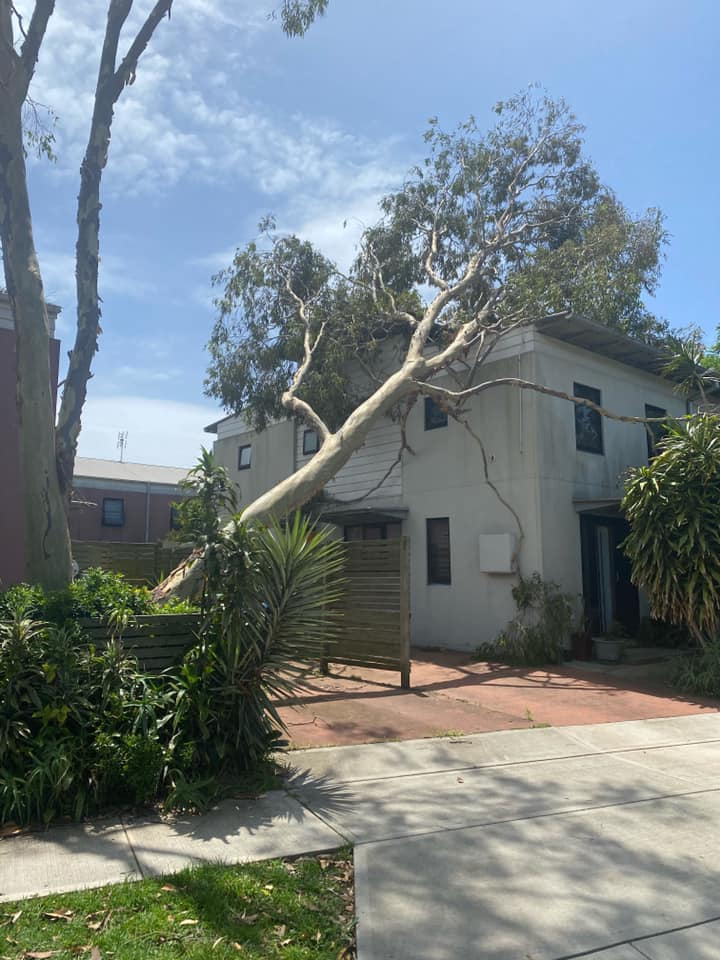
In cases where a tree or limb has already fallen or is leaning dangerously after a storm, this constitutes emergency tree removal. In such instances, a phone call is more appropriate than submitting a form. Ensure the area is safe, keep everyone at a distance, and contact us. If the tree poses a risk but is not an immediate emergency, our dangerous and storm-damaged tree removal service is what you require.
Understanding Your Rights Regarding Neighbouring Trees
The rules regarding a neighbour's tree vary accordingly.
In Lake Macquarie, you may prune branches from a native tree that overhangs your property back to the boundary, provided the pruning does not exceed 10 per cent of the tree's canopy and is performed according to accepted industry standards. If you wish to prune more than 10 per cent, you must obtain council approval. Lake Macquarie encourages you to discuss the matter with your neighbour beforehand, engage a qualified arborist for the work, and ensure that any offcuts remain on your side as green waste instead of being thrown back over the fence.
Lake Macquarie City Council clearly states that it will not intervene in disputes between neighbours regarding trees. Such matters are civil issues under the Trees (Disputes Between Neighbours) Act 2006, and the council advises individuals to consult with a solicitor, the Community Justice Centre, the Chamber Magistrate at the Local Court, or the Land and Environment Court. We have prepared a detailed guide outlining the steps to take if a tree is causing a dispute with a neighbour in NSW.
Steps to Take Before Booking Tree Removal
- Determine which council area the tree is situated in. Newcastle and Lake Macquarie enforce different regulations.
- Measure the trunk circumference at 1.4 metres above ground level, as well as the distance from the trunk to the nearest dwelling or swimming pool. These measurements are crucial for determining the exemptions applicable in Newcastle.
- Verify whether the property is heritage-listed, located within a heritage conservation area, or subject to native vegetation constraints. If any of these apply, the aforementioned exemptions no longer apply.
- If you reside near bushland, consult the RFS 10/50 tool, and check it again on the day of any clearing activities.
- In Lake Macquarie, start by using the council’s Tree Removal Assessment Tool to obtain an immediate answer.
- If you are still uncertain about the tree's status, arrange for an assessment. We can identify the species, evaluate its condition, and inform you of the applicable options for your tree.
Once you have secured the necessary approvals, or have verified that the tree is exempt, proceeding with the removal is straightforward. If approval is unlikely to be granted, or if the tree can remain, pruning is often a preferable alternative for the tree's health.
Common Questions from Newcastle and Lake Macquarie Homeowners Regarding Council Approval
Is council approval necessary to remove a tree in my backyard?
Not necessarily. In Newcastle, a tree under 3 metres tall, or one with a trunk circumference of under 450 millimetres at 1.4 metres, or located within 3 metres of a dwelling, a structure over 20 square metres, or a swimming pool, is exempt as long as the land does not have heritage or Aboriginal heritage constraints. In Lake Macquarie, the requirement depends on whether the tree is a native species or an Araucaria pine, and the council’s assessment tool will provide the answer.
Can I remove a dead tree without obtaining approval?
In Newcastle, yes, provided the tree is dead or storm-damaged and is not a habitat tree, is not located on heritage-listed land, is not visible from public spaces in a heritage conservation area, and is not part of an Aboriginal object or place of heritage significance. In Lake Macquarie, you should use the Tree Removal Assessment Tool, as the requirements depend on the species involved.
What are the council fees for approving a tree removal?
Both councils impose an application fee. The City of Newcastle indicates that fees vary based on a range of factors and provides an estimate during the online application process. Lake Macquarie collects fees at the time of lodgement. For the most accurate information, check the current fees directly with the council, not with us.
Can you provide the necessary documentation for my council application?
No. The City of Newcastle mandates a Level 5 consulting arborist's written assessment with the Private Tree Removal application, which must be prepared by a consulting arborist who specializes in this work, not by us. We perform the tree removal once your approval is granted.
How long does it take for a Newcastle tree removal application to be processed?
The City of Newcastle typically processes most tree removal permit applications within 30 days. If the tree is heritage-listed or situated within a heritage conservation area, the processing time may be extended as it will be referred to the council's Heritage Officer for evaluation.
If you are still unclear about your tree's status, please give us a call at (02) 4956 6602. Steven or our team can examine the tree, identify its species, and clarify which options are applicable to your property before you incur any expenses on an application.
We are qualified arborists serving Newcastle, Lake Macquarie, Maitland, and the Hunter region since 1998.
References for the Rules Presented on This Page
- City of Newcastle, Trees in Newcastle: https://newcastle.nsw.gov.au/living/environment/trees
- City of Newcastle, Private Tree Removal: https://newcastle.nsw.gov.au/about-us/forms-and-publications/forms-and-permits/private-tree-removal-application-form
- City of Newcastle, Trees and Vegetation services: https://newcastle.nsw.gov.au/about-us/report-an-issue-or-request-assistance/trees-vegetation
- Newcastle Urban Forest Technical Manual, Part A Private Trees: https://newcastle.nsw.gov.au/getmedia/B358FCFF-8E6A-4CA6-B1AD-DD0F7BA38DD9/1-Part-A-Private-Trees-Newcastle-Urban-Forest-Technical-Manual.pdf
- Lake Macquarie City Council, Tree pruning and removal: https://www.lakemac.com.au/Services/Trees-and-environment-services/Tree-pruning-and-removal
- Lake Macquarie Tree Removal Assessment Tool: https://www.lakemac.com.au/Services/Trees-and-environment-services/Tree-pruning-and-removal/Tree-removal-decision-tool
- NSW Rural Fire Service, 10/50 vegetation clearing: https://www.rfs.nsw.gov.au/plan-and-prepare/1050-vegetation-clearing
- NSW Rural Fire Service, check if you are in a 10/50 area: https://www.rfs.nsw.gov.au/plan-and-prepare/1050-vegetation-clearing/tool
Original Article First Published At: Do You Need Council Approval to Remove a Tree in Newcastle and Lake Macquarie?